
The Production Challenge Behind a Consistent LED Module
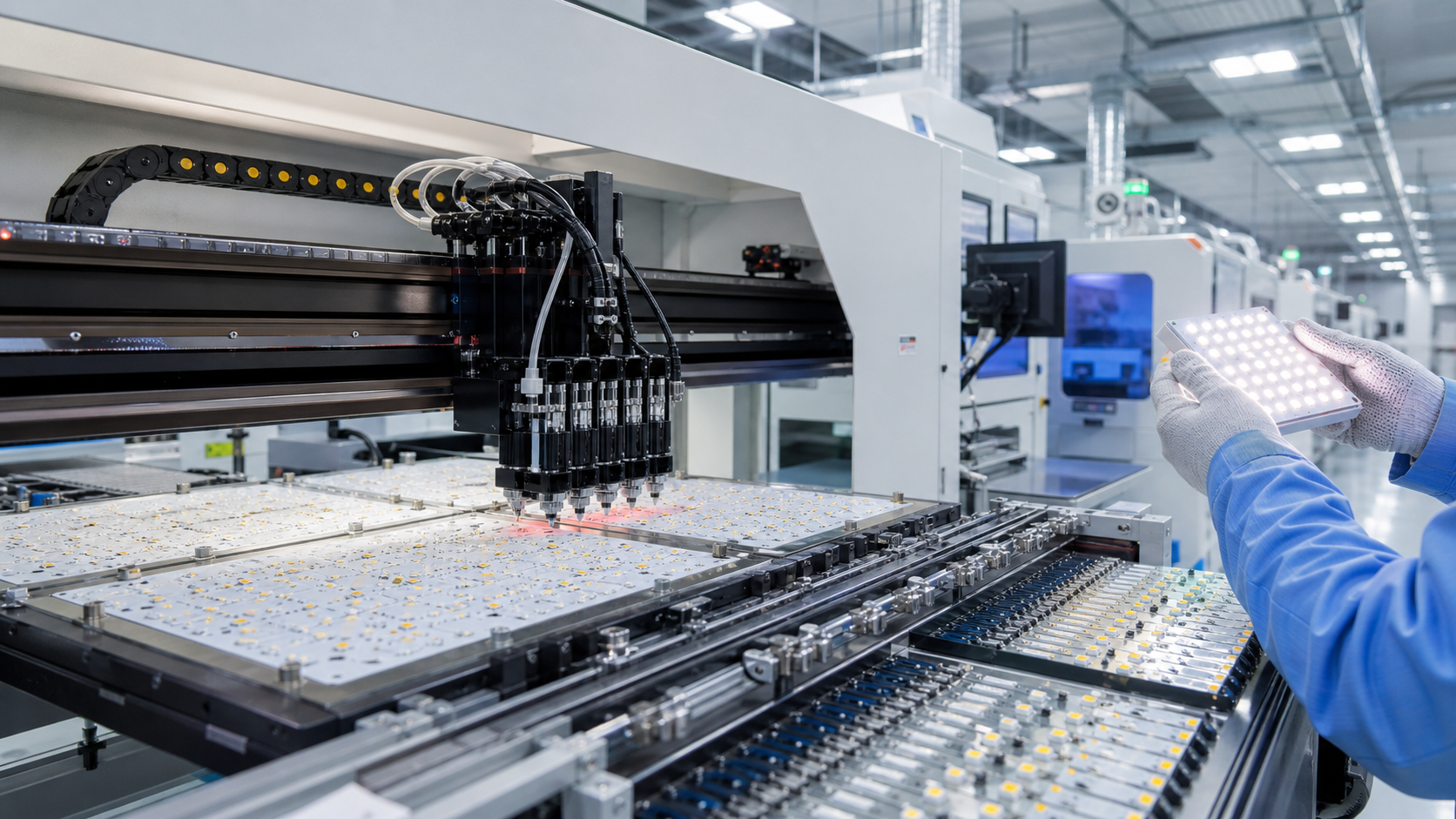
An LED module manufacturer needs more than high output. Buyers also expect stable brightness, accurate color, strong solder joints, and on-time delivery. Therefore, the production line must place small SMD LEDs accurately and protect them during handling.
A reliable LED module manufacturer also needs to find errors early. This helps each finished module meet the same quality standard. It also reduces rework, material loss, and delivery risk.
How an LED Module Manufacturer Plans Production
First, define the product requirements. List the PCB size, panel count, LED package types, target output, and model-change frequency.
Then review the board material and layout. Long boards, aluminum PCBs, and dense LED layouts can affect conveyor choice, placement settings, and the reflow profile. As a result, the SMT line should match the real product mix rather than a generic speed figure.
For LED products, a suitable LED pick and place machine should support the required package range, PCB dimensions, and production capacity.
Match the SMT Line to the LED Product
A complete SMT production line includes more than a placement machine. It may also include a PCB loader, stencil printer, conveyor, reflow oven, inspection equipment, and testing stations.
The best configuration depends on the product. For example, LED strips may need long-board transport. LED modules may need precise placement and stable thermal control. Meanwhile, mixed models may require fast feeder preparation and simple changeovers.
Therefore, manufacturers should balance speed, accuracy, flexibility, and maintenance requirements before selecting equipment.
Control Three High-Impact Process Steps
Next, focus on three core production steps.
First, solder paste printing must be consistent. Poor paste deposits can cause open joints, insufficient solder, or solder bridges. Operators should control stencil quality, paste condition, alignment, and printing pressure.
Second, the placement machine must align each LED accurately. Feeder condition, nozzle selection, vision recognition, and board support all affect placement quality. Gentle and stable handling also protects sensitive LED components.
Finally, the reflow profile must suit both the PCB and the LED package. Excessive heat can affect LED performance. An unsuitable profile can also create weak solder joints. When these three steps are stable, yield improves before the product reaches final test.
Use Inspection to Protect Brand Quality
After reflow, inspection protects product quality. AOI inspection equipment can identify missing parts, polarity errors, offset components, tombstoning, and solder bridges.
In addition, electrical and lighting tests should confirm illumination, current, and color performance. Keep records of defects, rework, and yield by product model. Then the team can find the root cause during the next run instead of repeating the same loss.
Plan Capacity for Seasonal Orders
Seasonal demand can create short order peaks. For this reason, balance printing, placement, reflow, inspection, and testing capacity. Do not let one station become the bottleneck.
Also plan feeder setup, offline preparation, changeovers, spare parts, and technical support. This is especially useful when teams are preparing for autumn sourcing and Q4 production.
What to Send for a Line Evaluation
Finally, prepare the BOM, Gerber files, centroid data, panel drawing, component packages, target output, and acceptance criteria. With this information, a supplier can estimate cycle time and recommend suitable LED SMT equipment.
A clear evaluation turns an equipment purchase into a repeatable manufacturing capability. For more information about ETON equipment and factory capabilities, visit the ETON Automation official website.